
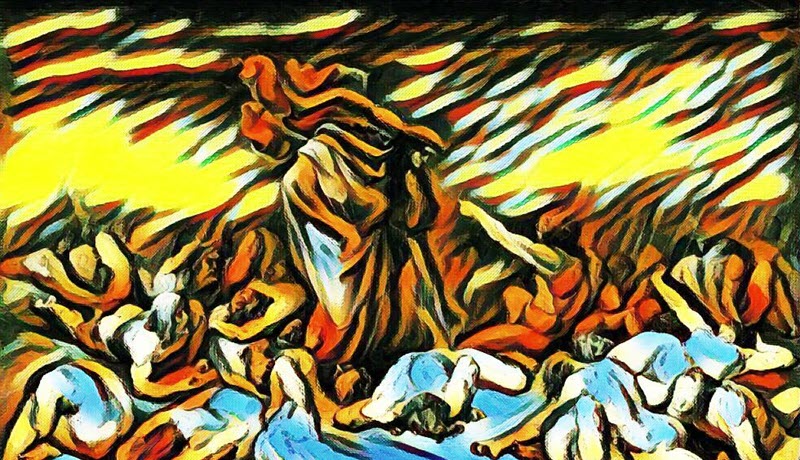

As he journeys through Hell (the Inferno) Dante encounters a number of characters and lost souls, who actually existed in real life. This article discusses the identity of the characters and their significance in Dante's Inferno.
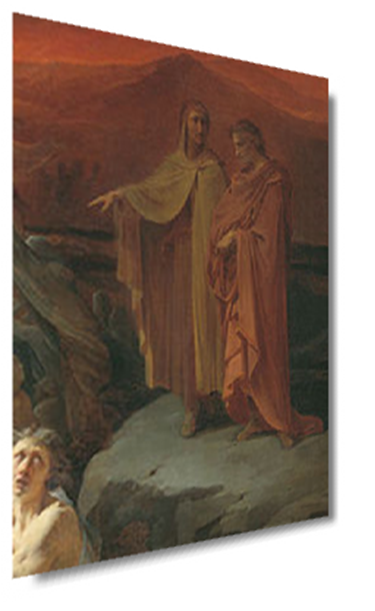
Dante -- the author appears in his own book as the protagonist. He is the only living person in the Inferno, as he is allowed to enter, unharmed, the Gates of Hell and witness the suffering that awaits sinners. He is guided through hell by the soul of the Roman poet Virgil, one of the great poets, whom Dante seeks to emulate. Dante the poet and Dante the character have
Virgil -- Virgil serves as Dante's guide through Hell. The real Dante was a poet who lived in northern Italy during the Roman era. Virgil was regarded as the greatest Roman poet, and his classic, the Aeneid which tells of the mythological journey of a group of Trojan survivors after the fall of Troy as they journey from their homeland to Italy, where they found the City of Rome.
Virgil has been condemned to Hell because he worshipped the old pagan gods, and lived before the time of Christ and so had no possibility of Redemption. The spirit of Virgil has been ordered to be Dante's guide. Throughout the journey, Virgil is a useful guide and companion to Dante but is sometimes powerless to protect Dante from the real dangers of the Inferno. Some critics regard Virgil as an allegorical representation of reason, as opposed to faith in God, and his inability to protect Dante from the dangers of Hell symbolizes the ineffectiveness of pure reason compared to belief in Christ. The choice of Virgil as a guide is significant because prior to his entry into Hell, Dante aspires to be like Virgil.
Beatrice -- Beatrice is a young woman, and Dante's true love. She is pure of heart and has been allowed to enter Heaven. Dante is distraught by her loss and at the beginning of the Inferno, he has become lost (literally and metaphorically). In the depth of his despair, Dante is contemplating suicide. Beatrice saves him by asking an angel to send Virgil to Dante and allowing Dante to make the journey through Hell, Purgatory and Heaven which corresponds to Dante's spiritual ascent from the depths of sin to redemption. Beatrice is not present in most of the Inferno, but she is Dante's personal guide through Purgatory and Heaven.
In real life, Beatrice died very young. It is unclear whether Dante really knew her well, or whether he merely used her as an allegory for spiritual love.
In addition to the main characters, Dante encounters a large number of minor mythological creatures and demons as well as souls of the damned, based on real people. Some of these encounters are very fleeting in nature, while at other times Dante stops to converse with the spirits.
Fra Alberigo and Branca d'Oria - Like many of the other souls that Dante encounters, these characters are based on real people. The difference between these two men and the others is that they were still when Dante wrote the Inferno. Dante explains their presence in Hell by saying that they were so sinful that the devil did not wait for them to die before snatching their souls. The now soulless bodies of Alberigo and D'Oria are still living, animated by demons that have taken possession of their bodies. Obviously libel laws were not that strict in Medieval Italy.
Fra Alberigo was a friar and member of the Guelph political party in Florence. Alberigo had his cousin and his son killed when they were guests at a banquet hosted by Alberigo. This act of treachery earned Alberigo a place in the Ninth Circle of Hell.
Antaeus - Antaeus is a giant borrowed from Roman mythology. In the Inferno, he transports Dante and Virgil from the Eighth to the Ninth Circle of Hell.
No entries yet.
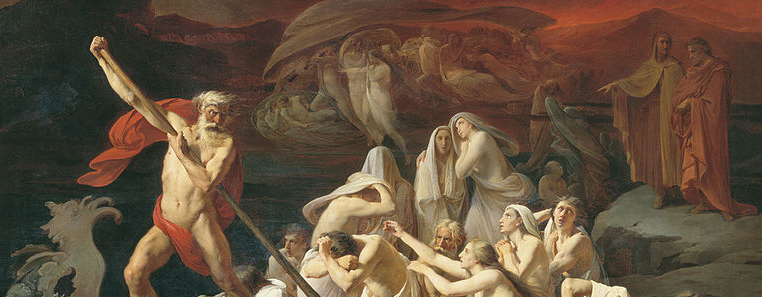
Charon - In Greek mythology, Charon was the ferry man who ferried the souls of the dead over the river Acheron to Hell. He is not an entity recognized in Christian mythology of Biblical teaching. Dante has adopted this figure because of the powerful poetic imagery of this archetypal myth.
No entries yet.
No entries yet.
Farinata - In real life Farinata was a political leader in Florence, and a leader of the Ghibelline party, whom Dante opposed. Once again, Dante is letting his own political views determine who will be damned to Hell. In the Inferno, Dante comes up with a particularly cruel punishment for Farinata: he is damned to observe the political events in Florence, without being able to influence them.
Filippo Argenti - Another Florentine and political enemy of Dante in real life. In the Inferno, Argenti is condemned to the Fifth Circle of Hell. He is to spend eternity among the Wrathful (his sin in life) who reside in the river Styx.
Geryon - The massive serpentine monster that transports Dante and Virgil from the Seventh to the Eighth Circle of Hell.
Guido da Montefeltro - Another adversary of Dante in Dante's real life political career. Montefeltro was an advisor to Pope Boniface VIII (himself now residing in Hell). This corrupt man sold Papal indulgences which promised forgiveness and absolution from sins before they were even committed. In effect they served as licenses to commit the offence with supposed impunity. But of course, it was just a scam for profit which led many to spiritual ruin. It is not possible to be forgiven for a sin without repentance. And it is impossible to repent of a sin before committing it. This Montefeltro's indulgences were invalid. Ironically, Montefeltro now suffers eternal torment because he did not repent.
Harpies - monsters from Greek mythology having the appearance of a winged woman with talons. In the Inferno, they torment the souls of those who have committed suicide.
No entries yet.
No entries yet.
No entries yet.
Lucifer -- The Devil. He resides at the very bottom of the Inferno, in the Ninth Circle of Hell. He is represented as an enormous giant with his body jutting out of a frozen lake. In Dante's conception, Lucifer has three mouths which are busy eternally chewing three of the greatest traitors in history: Judas, who betrayed Christ, and Cassius and Brutus who betrayed Julius Caesar. The Ninth Circle of Hell is reserved for the worst sinners: the betrayers and traitors. Lucifer is himself a traitor and betrayer. As an angel in the service of God, Lucifer rebelled against God and was cast out of Heaven to Hell.
Minos - In Greek mythology, Minos was the king of Crete. He built a labyrinth, in which he kept the half beast, half man Minotaur. He would sacrifice youth to the Minotaur by trapping them in the labyrinth with the beast. In the Inferno, Minos is himself portrayed as a giant beast. He stands at the entrance to the Second Circle of Hell and hears the confessions of the sinners that enter. Upon hearing their sins, King Minos signals with his tail to which circle of hell they will be sent.
Malacoda - Malacoda is one of the demons who reside in the Inferno. His name means evil tail" in Italian. Malacoda is a the leader of a the demons who guard a part of the Eight Circle of Hell. He gives Virgil and Dante misleading directions.
Muhammad (c. 570–632): The founder of Islam. According to Dante, he is found among "the sowers of dissension".
Nessus - Nessus is a Centaur (half man and half horse), and a figure from Greek mythology. In the Inferno, this centaur carries Dante through the First Ring of the Seventh Circle of Hell.
No entries yet.
Paolo and Francesca da Rimini - Paolo began an adulterous affair with his sister in law Francesca. They were killed by Francesca's husband and now spend eternity among the sexual sinners.
Pope Boniface VIII - This Pope was notoriously corrupt, and sought to increase the political power of the Papal States which were the territories in Italy ruled directly by the Pope. In placing this Pope in Hell, Dante is taking a shot at his real life political adversaries. The real Dante belonged to a political faction in Florence that opposed the temporal power of the Pope.
Phlegyas - The boatman who rows Dante and Virgil across the river Styx.
Pier della Vigna - One of the suicides that Dante encounters in Hell. Della Vigna was an advisor to Emperor Frederick II. He killed himself after he fell out of the emperor's favor.He now must spend eternity in the form of a tree.
No entries yet.
No entries yet.
No entries yet.
Ulysses -- This is another character borrowed from Greek mythology. In the myths, Ulysses was the hero of the Homeric epics the Iliad and the Odyssey, a warrior during the Trojan wars. In this respect there is a connection between Ulysses and Virgil because Virgil's Aeneid picked up where the Iliad and the Odyssey ended. He is confined to the Eighth Circle of Hell. He conceived of the trick of the Trojan Horse and has been condemned to hell for the sins he committed during the Trojan Wars.
Count Ugolino -- Another Italian political figure of Dante's era. Ugolino has been condemned to the Ninth Circle of Hell, the worst part of Hell which is reserved for traitors. In the Inferno, Ugolino is condemned to eternally eat the head of another traitor, Archbishop Ruggieri. In the real world, Ruggieri had imprisoned Ugolino and his sons, without food in order to starve them to death. Ugolino had eaten his sons.
Vanni Fucci - Another character based on a real life person known to Dante. In both the Inferno and in real life Fucci was a thief. He has been sentenced to spend eternity in the Eight Circle of Hell. When Dante meets him, Fucci is defiant and curses God and makes an obscene gesture at Him. He also predicts that the White Guelphs, one of the political factions in Florence at the time, and enemies of Dante, will be defeated.
No entries yet.
No entries yet.